Why skeleton watches shouldn’t be kept in the cupboard
Luxury watches aren’t exactly known for being shy. Some have enormous cases, while others sparkle with enough diamonds to make your sunglasses redundant. But perhaps the most interesting way of showing off is to simply take the dial away altogether.

A skeleton watch exposes parts of its movement, allowing you to see the intricate mechanics working beneath the dial. Rather than hiding away those tiny gears, springs, bridges and wheels, the watchmaker puts them firmly on display.

And why not? If you’ve spent countless hours creating an incredibly complicated mechanical movement, it seems a shame to hide it behind a piece of metal.
What is a skeleton watch?
The terms skeletonised and openworked are often used interchangeably, although there is a slight difference.

A skeletonised watch typically has sections of the movement removed to reveal more of what’s going on underneath. An openworked watch takes the idea even further, stripping back much of the movement to create an almost architectural effect.

The result can be spectacular. Instead of simply looking at a dial and wondering what is happening underneath, you can actually watch the balance wheel oscillate and the gears turn as the watch keeps time.

It’s a little bit like taking the bonnet off a supercar. You don’t necessarily need to see the engine to know the car works, but seeing all that machinery doing its thing makes the experience all the more interesting.
Why do luxury watchmakers do it?
Well, it looks fantastic, for one. But there’s way more to it than aesthetics.
Skeletonisation is a chance for a watchmaker to show off its craftsmanship and engineering. Removing sections of a movement isn’t simply a case of getting out a pair of scissors and hoping for the best. The remaining components need to retain their strength and function correctly, while the edges and surfaces can require extensive finishing and decoration.

At the higher end of watchmaking, this is an art form in its own right.
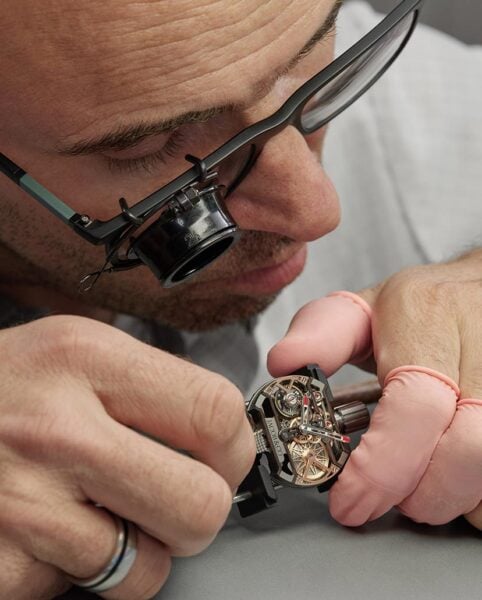
It also changes the relationship between the wearer and the watch. You’re no longer simply looking at the hands moving around a dial; you’re seeing the hundreds of tiny components working together to make those hands move in the first place.
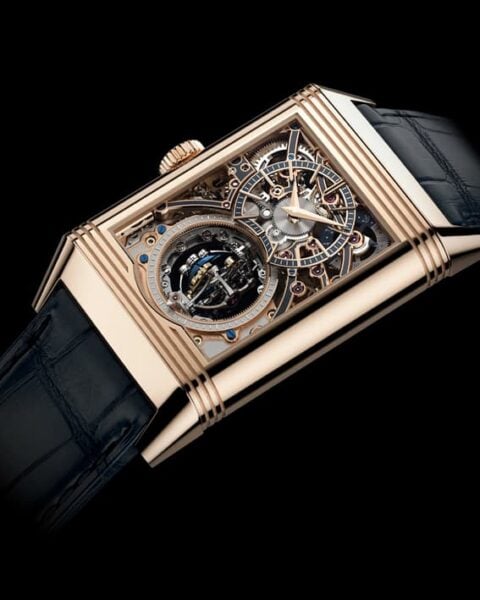
And there’s something rather satisfying about being able to see where all that money went.
Here are a few skeletonised and openworked watches that show just how impressive the genre can be.
Cartier Santos de Cartier Skeletonised Blue – WHSA0026
This Cartier Santos gets a contemporary twist with this striking skeletonised version. Its 40mm stainless steel case houses a navy-blue skeletonised dial, revealing the intricate automatic movement beneath, while matching blue hands add even more depth.
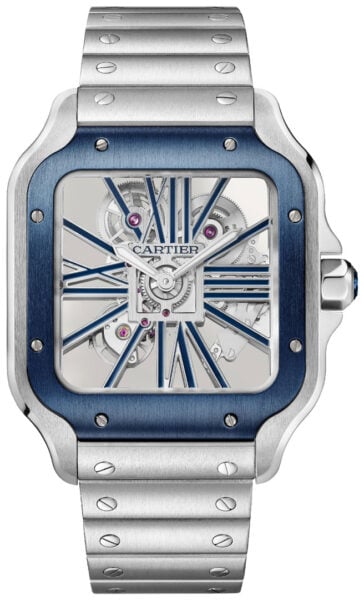
Priced at £20,495, it’s a great example of how skeletonisation can transform a familiar luxury watch into something fresh, technical and seriously eye-catching.

Audemars Piguet Royal Oak Perpetual Calendar Skeletonised – 26585CE
If the Cartier shows how skeletonisation can transform a familiar design, the Audemars Piguet Royal Oak Perpetual Calendar Skeletonised takes things to another level.

Its 41mm black ceramic case gives it a wonderfully stealthy appearance, but look closer and you’ll find an incredibly intricate skeletonised movement on display. The openworked design is paired with a perpetual calendar, one of traditional watchmaking’s most impressive complications, keeping track of the day, date, month and leap years.

At £310,000, it’s certainly not an impulse purchase – unless your definition of an impulse purchase is considerably more extravagant than ours. But it perfectly demonstrates how skeletonisation can combine serious technical watchmaking with spectacular design.
Audemars Piguet Royal Oak Tourbillon Extra-Thin Openworked – 26518ST
We love the Royal Oak Tourbillon Extra-Thin Openworked, which really does put the movement centre stage.
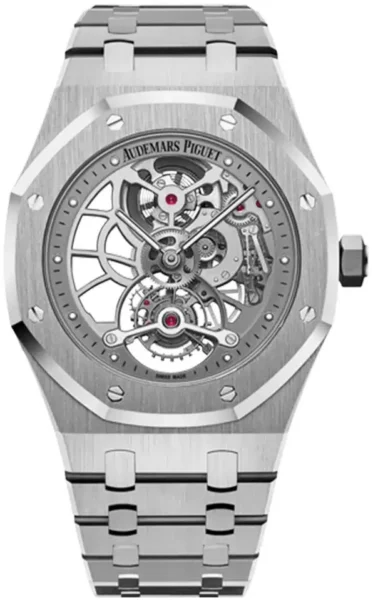
The 41mm stainless steel case houses a beautifully openworked manual-winding movement, giving you an unobstructed view of the intricate mechanics inside. And, as the name suggests, there’s also a tourbillon – one of the most famous complications in high-end mechanical watchmaking.
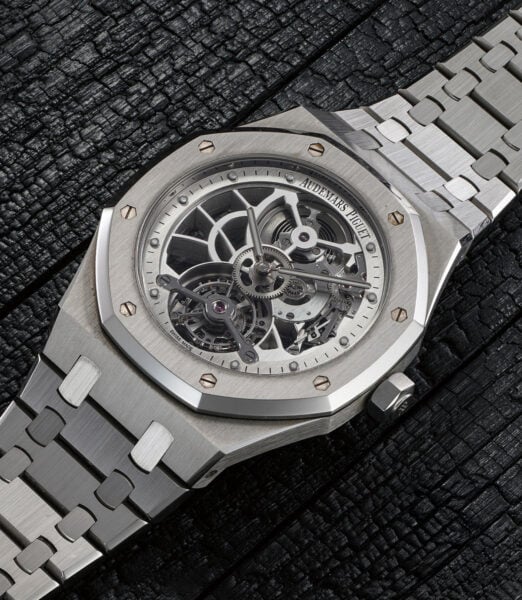
Limited to just 100 pieces, there’s plenty of exclusivity here too. But what really makes it special is the way Audemars Piguet has managed to make the mechanics part of the design rather than something hidden away underneath it.

It might be a little beyond the average watch collection budget, but you certainly wouldn’t struggle to find something to admire.
Cartier Santos Dumont Skeleton – WHSA0031
The Cartier Santos Dumont Skeleton takes a more refined approach to skeletonisation. Its petite 31mm 18ct yellow gold case, leather strap and exposed mechanics give it a dressier feel, while the skeletonised dial adds plenty of technical interest.

Limited to just 150 pieces, it’s a beautiful example of how skeletonisation doesn’t have to be futuristic or flashy. Sometimes, a little sneaky peep of the mechanics is all you need. Currently POA at Luxe Watches.

Nothing to hide
There’s something particularly appealing about a skeleton watch. It takes something that is normally hidden and makes it the main attraction.
And perhaps that’s why these watches continue to appeal to collectors. They’re not just about telling the time… they’re about showing you how the time is being made.
So, if you’ve got a skeleton watch sitting in the closet waiting for a special occasion, perhaps it’s time to get it out!
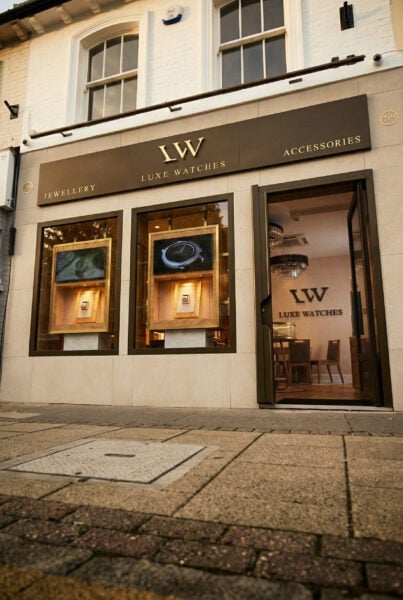
We stock a wide range of luxury watches, including a selection of beautiful skeletonised and openworked timepieces. Why not visit us in Epping?